Accurate point level detection as well as continuous level, interface and density measurement are essential for safe and efficient operation in industries handling a wide variety of media. The radiometric measuring principle offers a robust solution for these demanding applications, especially when conventional measuring principles reach their limits.
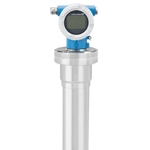
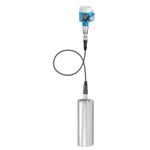
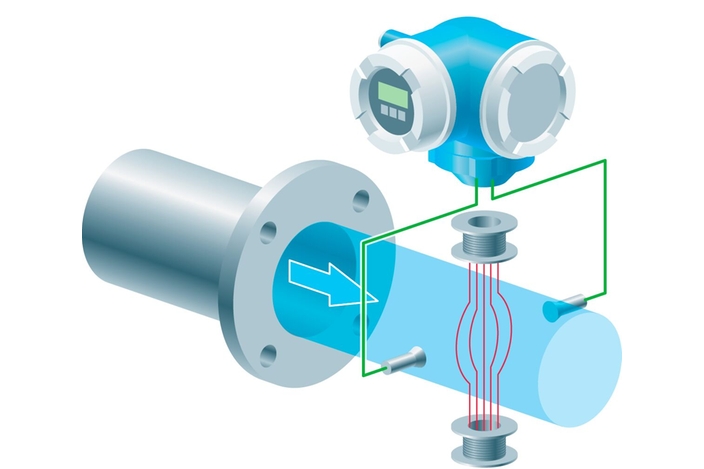
This technology uses gamma radiation emitted by a radioactive isotope to penetrate tanks or pipelines from the outside. The radiation is attenuated depending on the medium’s density and level. This change is precisely detected by a compact transmitter.
Radiometric measurement works independently of the physical and chemical properties of the medium, such as corrosiveness, toxicity, or abrasiveness, and is unaffected by extreme conditions like high pressure or high temperature.
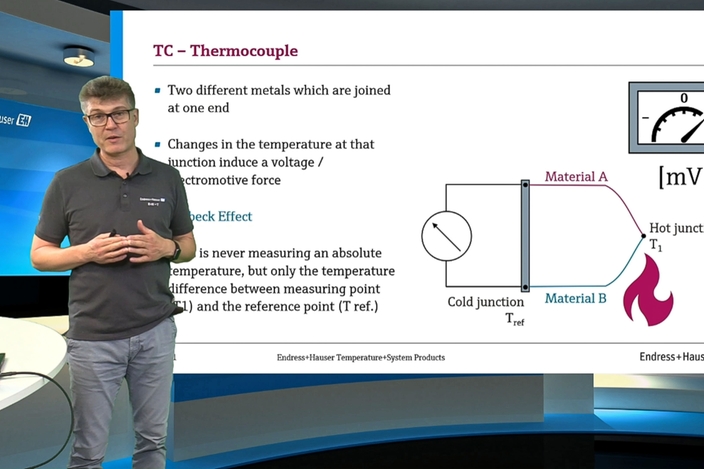
Watch the video to learn how the radiometric measuring principle works.
Advantages of radiometric devices at a glance:
- Universal application for liquids, bulk solids, suspensions and sludges
- Independent of media properties such as density, viscosity or conductivity
- Ideal for extreme process conditions where other measuring principles cannot be applied
- Non-contact measurement from outside the process vessels like reactors, autoclaves, separators, acid tanks and cyclones
- Robust design for maximum operational safety
The most varied media are filled into and drained via pipes from tanks every day. Examples are potable water, fruit juices, oils and fuels, acids or brines. Since these media can have completely different properties, there are different measuring principles to detect them. For example, radiometric level measurement by gamma radiation. As early as 1896, Henri Becquerel experimented with uranium salts and found that these blackened the photographic plate which indicated emitted radiation. He is considered to be the discoverer of radioactivity and to honor him, the SI unit is called Becquerel. One Becquerel corresponds to one radioactive decay per second. In 1897, Marie Curie did further research on the radiation of uranium compounds and coined the word radioactive. To honor her, the activity measurement unit was called Curie.
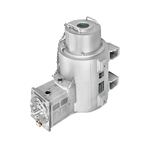
Radiometric instrumentation can be used to detect continuous level, point level or density in tanks or pipes. This is usually done by gamma radiation. Let's have a closer look at how this measurement method works. As a radioactive isotope decays, radiation is emitted in form of particles or electromagnetic waves. Alpha and beta radiation are particle radiations. Gamma radiation is an electromagnetic wave. In industrial instrumentation cesium 137 or cobalt 60, which only emit beta and gamma radiation, are mostly used as radioactive isotopes. The isotope is installed in a double walled stainless-steel capsule which shields the beta radiation completely. In industrial instrumentation thus, only gamma radiation is used. The radioactive radiation source is shielded by the source container in such a way that the gamma radiation can only be emitted in a certain direction. The source container is arranged on one side of the tank. On the opposite side, the compact transmitter is located to detect the radiation. This gamma radiation is used to radiate through tanks and pipelines from outside.
As materials are penetrated, the radiation is attenuated by the density of the medium and the material thickness. The emitted gamma radiation is detected by the compound transmitter. As this occurs, a gamma photon of the scintillator is converted into a flash. This flash is transmitted to the photomultiplier in the scintillator, as is the case in a glass fiber line. In the photo cathode, the flash is converted into a very low charge, which is then amplified to an invaluable current pulse in the photo multiplier. The same is then processed to become a measuring signal. The higher the level or the higher the density, the more radiation is absorbed by the medium, whereby the radiation is reduced at the detector and converted into a corresponding measured value.
Instruments according to the radiometric measuring principle of Endress+Hauser facilitate the measurement of continuous levels, point levels and densities. Also, in the most adverse process conditions like high pressures or high temperatures, as well as in corrosive and abrasive media. We have the appropriate solution for any application. Endress+Hauser.